

I bought the Kolbs Bed Wedge Pillow in early January because I was tired of waking up at 2 a.m. with that burning taste in the back of my throat. I'm 44, I've had mild acid reflux for about six years, and I'd already tried the propping-two-pillows-under-my-head trick for months. It never held. By 3 a.m. I'd always slid back down flat, and the reflux would wake me right back up. Six months later, I've slept on this wedge almost every single night, and I want to walk through exactly what changed, what didn't, and where I think it's worth your money.
This isn't a first-week impression. This is what the foam looks like after 180-some nights, what my reflux log actually shows, and the honest tradeoffs nobody mentions in the five-star reviews.
The Quick Verdict
A firm, properly-angled wedge that actually stopped my nighttime reflux within two weeks and held its shape for six months. Not a mattress-topper level of comfort out of the box, but it does the one job it's built for.
Amazon Check Today's Price →Still sliding down flat by 2 a.m.? That's not a willpower problem, it's an angle problem.
Stacked pillows collapse because they're not built to hold an incline. The Kolbs wedge is cut at a fixed 7.5-inch rise so gravity works for you instead of against you, all night, without you having to re-stack anything at 3 a.m.
Amazon Check Today's Price on Amazon →How I've Used It
I set the wedge up on my side of a queen bed, foam side down, with a fitted cotton sheet stretched over the whole thing so it doesn't feel like I'm lying on bare foam. I sleep on my back about 80% of the time and on my right side the rest, and I tested it both ways deliberately for the first month to see which position held up best against reflux.
For the first two weeks I kept a simple nightly log in the Notes app: did I wake up with heartburn, yes or no, and roughly what time. Weeks one and two were rough, my body was still used to sleeping flat and I woke up a few times feeling like I'd slid partway off the incline. By week three I'd stopped noticing the slope at all. It just became how I sleep.
I also used it for two solid weeks after a minor lower-back flare-up in March, elevating my knees on a second wedge my sister had, with this one under my back and shoulders. That combination took real pressure off my lower spine in a way flat sleeping never did.
By April I'd stopped thinking of it as a piece of medical equipment and started thinking of it as just my pillow. That shift mattered more than I expected. The nights I traveled without it, twice for work trips, I noticed the difference immediately, both in reflux and in how stiff my neck felt in the morning. That's when I knew the wedge itself, not just the general idea of elevation, was doing real work.
The Foam and the Angle, Six Months In
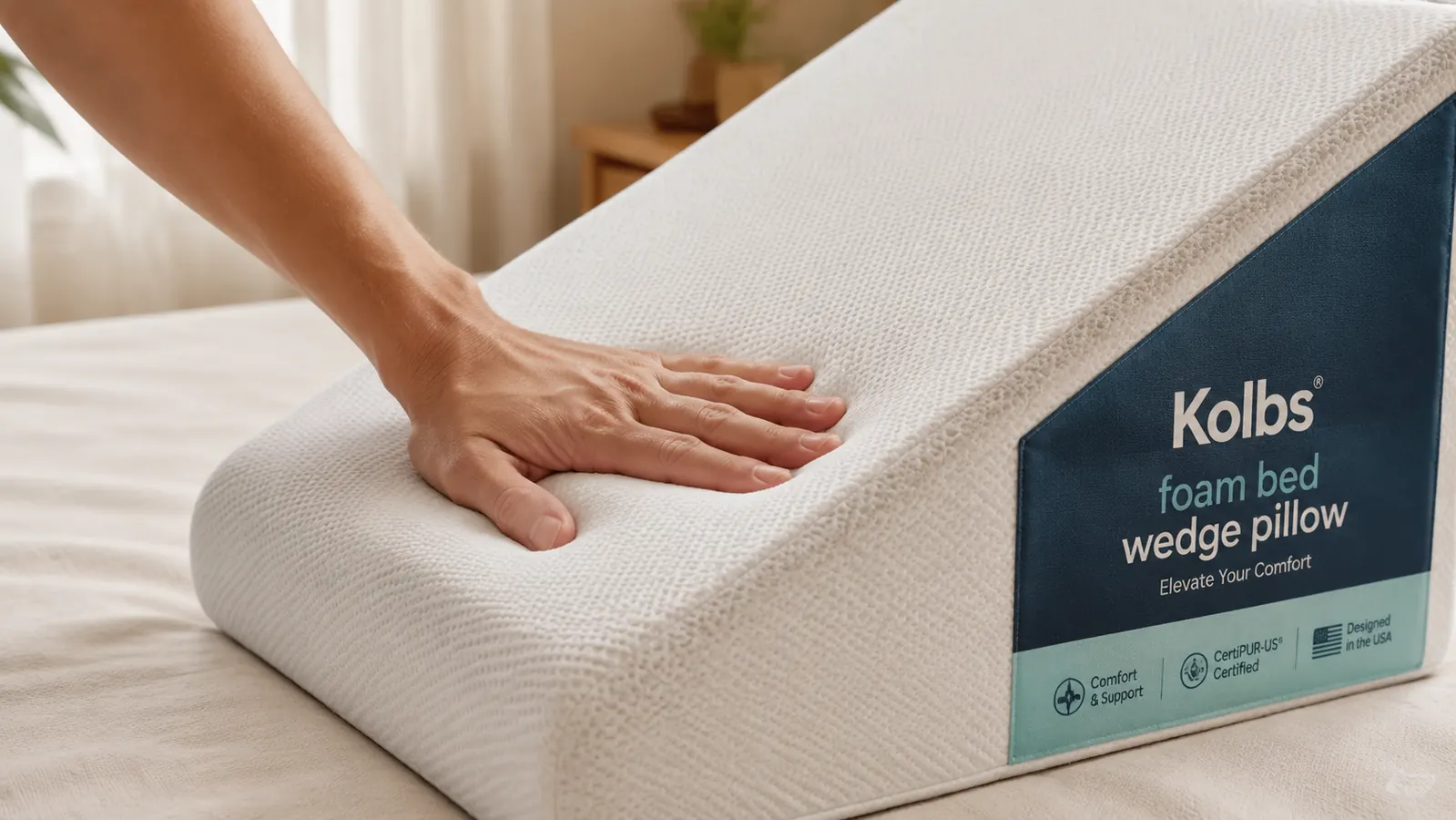
The Kolbs wedge is a single solid piece of firm foam, not the softer memory-foam-on-top style some competitors use. That firmness is exactly why it works. Softer wedges compress under your body weight over a few months and the angle flattens out, which defeats the whole purpose. Six months in, mine still holds close to its original 7.5-inch rise. I measured it against a photo I took on day one, and there's maybe a quarter-inch of settling at most.
The tradeoff is that it's firm. If you're used to a plush pillow-top feel, the first few nights will feel more like sleeping on a padded ramp than a pillow. I noticed this most under my shoulder blades before I started using it with a sheet and a thin flat pillow layered on top for my head specifically. Once I added that thin pillow, the firmness stopped bothering me.
The cover is a removable, machine-washable velour-style fabric. I've washed mine three times over six months, mostly because my dog occasionally jumps up and leaves hair on it. It's held its shape and color fine, no pilling, no fading.
One detail that surprised me: the foam has almost no off-gassing smell, even fresh out of the box. My husband is sensitive to that chemical new-foam scent and usually makes me air things out on the porch for a day or two. This one aired out in an afternoon and he never mentioned it again after that.
What Happened to My Reflux, Specifically
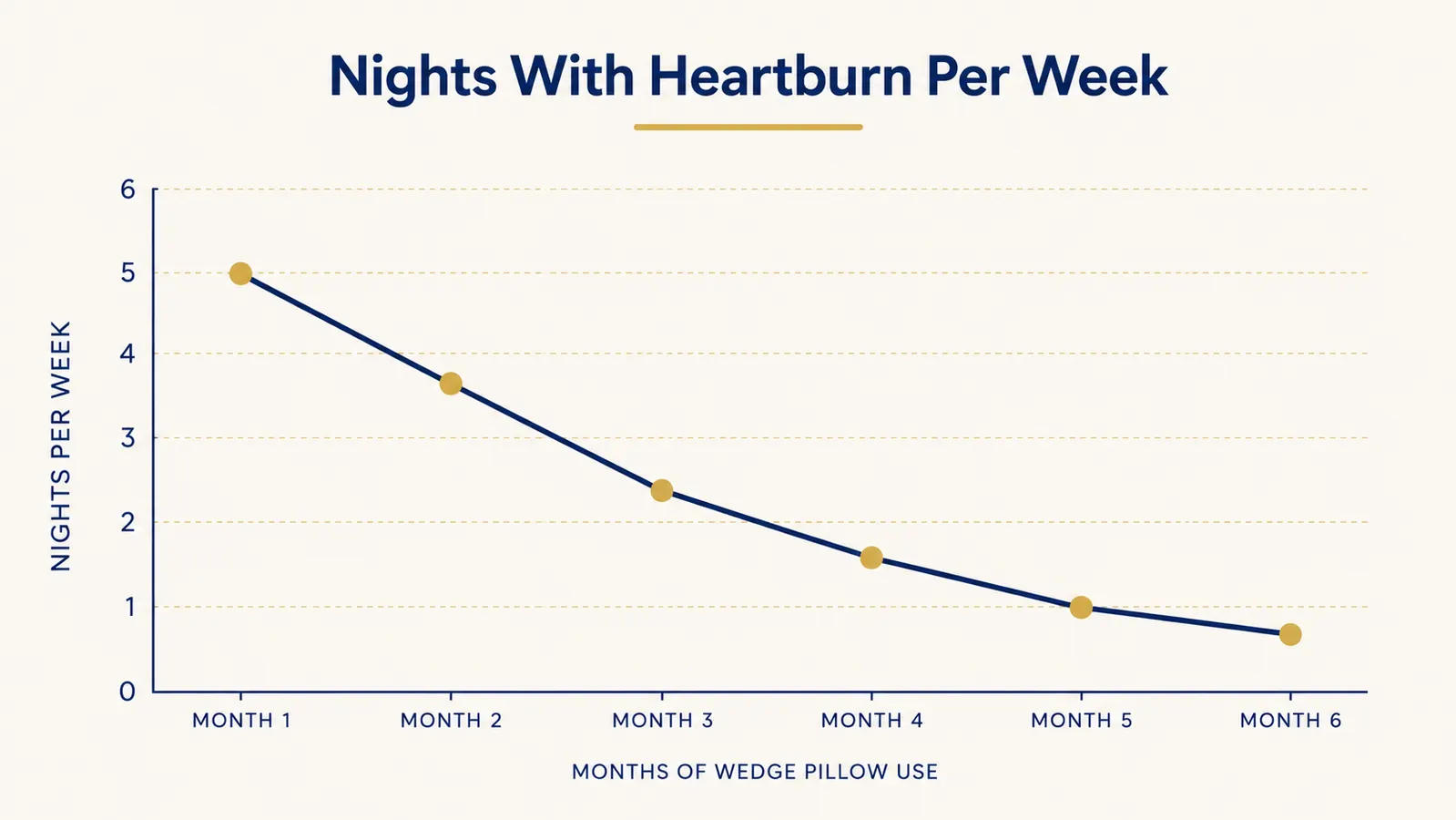
Here's the part that matters most to me. In the two weeks before I started using the wedge, I was waking up with heartburn 5 to 6 nights a week, almost always between 1 and 3 a.m. By week four on the wedge, that dropped to about 2 nights a week. By month three, it was down to roughly 1 night every other week, usually only after a late dinner or wine with a meal, which tells me the timing of eating still matters more than the pillow ever will.
I'm not a doctor and this isn't medical advice, my GI doctor still has me on a low-dose PPI for the underlying reflux. But the wedge visibly changed how often the reflux actually reached my throat at night, which is the whole mechanism behind elevation therapy: keeping stomach acid below the esophagus instead of pooling at the same level when you're flat.
What I didn't expect was how much the daytime version of me improved too. Fewer 2 a.m. wake-ups meant I was actually getting full sleep cycles again, and by month two my afternoon energy crash at work had noticeably eased up. That's not something the product packaging promises, and I want to be careful not to oversell it, but disrupted sleep from reflux was clearly costing me more than I'd realized.
If you want the deeper mechanism explanation and a step-by-step on positioning it correctly, I wrote a full breakdown here: how to sleep with acid reflux using a wedge pillow.
Who Else Uses This in My House
My husband, who snores loudly enough to wake me even with earplugs some nights, borrowed the wedge for about three weeks in February when his own reflux flared up. He noticed less morning congestion and reported his own snoring seemed quieter to me, though I'll admit that's subjective since I wasn't logging decibels. Elevating the upper body is a commonly cited way to reduce snoring severity because it keeps the airway from collapsing as easily, and anecdotally that tracked with what I heard from across the bed.
I also let my mother try it for a week when she visited after a hip replacement. She used it under her knees instead of her back, and said it helped with the ache of lying flat post-surgery. That's not what it's marketed for, but the foam density held up fine under that different kind of pressure too.
The Sliding Problem, and How I Solved It
The one real complaint I have: on my slippery cotton-poly blend sheets, the wedge slid a few inches toward the foot of the bed most nights for the first month. Not enough to fall off the bed, but enough that I'd wake up flatter than I started. Two things fixed this almost completely. First, I stopped using a fitted sheet directly over the wedge and instead put a thin rubber shelf-liner grip mat underneath it, between the wedge and my mattress protector. Second, I pushed the wedge flush against my headboard so it has a wall to brace against instead of open space to slide into.
If you have a platform bed with no headboard, I'd budget for a cheap non-slip pad from the start rather than finding out the hard way like I did.
I've since heard from a couple of readers who solved the same slide with double-sided carpet tape instead of a grip mat, which is a cheaper fix if you already have some in a junk drawer. Either way, plan on doing something about grip. The wedge itself won't tell you it's sliding until you wake up flat and confused at 4 a.m.

Size and Fit for a Queen Bed
The wedge is sized for one person, roughly 24 inches wide. On our queen bed, it takes up my half and leaves my husband's side completely flat and untouched, which is exactly what we wanted since only I needed the incline most nights. If both people in a bed need elevation, you'd want two of these side by side rather than expecting one to cover a full queen or king width. I go into more detail on width and how it compares to just stacking your own pillows in my side-by-side comparison: Kolbs wedge pillow vs stacking extra pillows.
For anyone weighing whether a dedicated wedge is worth it over just buying more pillows, the honest answer after six months is that the shape is what does the work, not the amount of foam. Two or three regular pillows stacked will always want to shift apart from each other, because nothing is holding them together as one unit. The wedge is one continuous slope, so there's nothing to shift internally, only the whole piece sliding on the sheet, which is a much easier problem to solve.
What I Liked
- Held its 7.5-inch angle with only minor settling after 6 months of nightly use
- Noticeably reduced my nighttime heartburn episodes starting around week 3
- Removable, machine-washable cover held up through 3 washes with no pilling
- Dense enough that it also worked as knee elevation for a family member's post-surgery recovery
- Minimal off-gassing smell straight out of the box
- FSA eligible, which made it a no-brainer purchase for us
Where It Falls Short
- Firm foam feels more like a ramp than a pillow for the first week or two
- Slides on slippery sheets unless you brace it against a headboard or add a grip pad
- Only sized for one person, a shared bed needs two wedges
- Not a replacement for medical reflux treatment, it's a mechanical assist, not a cure
It stopped being a pillow I was testing and just became how I sleep. That's the real marker of whether gear like this works.
Who This Is For
If you have nighttime acid reflux, GERD, post-nasal drip, mild sleep apnea symptoms, or lower back pain that flat sleeping aggravates, this is worth trying before you spend money on an adjustable base, which runs hundreds more. It's also a smart pick if you've tried the stacked-pillows workaround and kept sliding down through the night. The firm foam holds an angle that soft pillows physically cannot, and unlike an adjustable bed frame, you can move it to a guest room or take it on a trip in a duffel bag.
I'd also point it toward anyone recovering from sinus surgery, a cold that won't drain at night, or pregnancy-related reflux in the third trimester, all situations where elevation is commonly recommended and a dedicated wedge holds its shape far longer than a pile of bed pillows.
Who Should Skip It
If you're someone who needs a soft, plush feel to fall asleep, or you have significant shoulder or hip pain that firm surfaces aggravate, you may want to add extra padding on top from day one rather than expect the wedge itself to feel cushioned. And if you and a partner both need elevation on one bed, plan to buy two rather than trying to squeeze both of you onto a single 24-inch-wide wedge.
Six months of nightly use later, this is still the first thing I recommend to anyone who describes my old 2 a.m. heartburn.
If stacking pillows has failed you the way it failed me, a properly angled wedge is the next logical step before anything more expensive. Check today's price and see if it's in stock at your size.
Amazon Check Today's Price on Amazon →