

I already told you the honeymoon version of this story. Six months in, the Kolbs wedge pillow is still on my bed and my acid reflux is still better than it was. That part is true. But if you read my long-term review and stopped there, you got the highlight reel. This is the other half, the part where I tell you what actually happened the first three weeks, what nobody photographs for the Amazon listing, and where I think this pillow will let you down if you're not the right shape, weight, or sleep style for it.
I'm Nora. I'm a light sleeper, I run cold most nights but hot-flash warm some others, and I've bought more sleep gear in the last two years than I care to add up. The Kolbs wedge pillow, the memory foam one marketed for acid reflux, sleep apnea, and back pain, is one of the few things that's actually earned a permanent spot on my mattress. That said, I'd be lying to you if I said it was smooth sailing out of the box, and I think a lot of the one and two star reviews out there come from people who hit these same snags and gave up before they worked through them.
The Smell, and the First Night
Nobody mentions the smell. Mine arrived vacuum-sealed and rolled tight, and when I cut the plastic open, it hit me with that unmistakable new-foam chemical smell, somewhere between a mattress store and a new car. I'd read enough reviews of other memory foam products to expect this, so I wasn't surprised, but if you're sensitive to smells, plan to let it air out in a spare room for two to three days before you put it on your bed. I didn't do that the first time. I unzipped the cover, fluffed it, and slept on it that same night, and I woke up with a mild headache I'm fairly sure was from the off-gassing, not the incline.
By night four the smell was basically gone. But that first week soured me a little, and I want you to go in with realistic expectations instead of the letdown I had when the listing photos showed a pristine white pillow and my actual pillow smelled like a hardware store. If I'd known to just unroll it in the garage for 48 hours first, I would have skipped that whole rough patch entirely.
The Quick Verdict
Genuinely helps with reflux and congestion once you adjust to it, but the firmness, sliding, and single-size design mean it's not the universal fix the marketing implies.
Amazon Check Today's Price →Still deciding if the trade-offs are worth it for your reflux nights?
Check today's price and current availability directly on Amazon before you commit either way.
Amazon Check Today's Price on Amazon →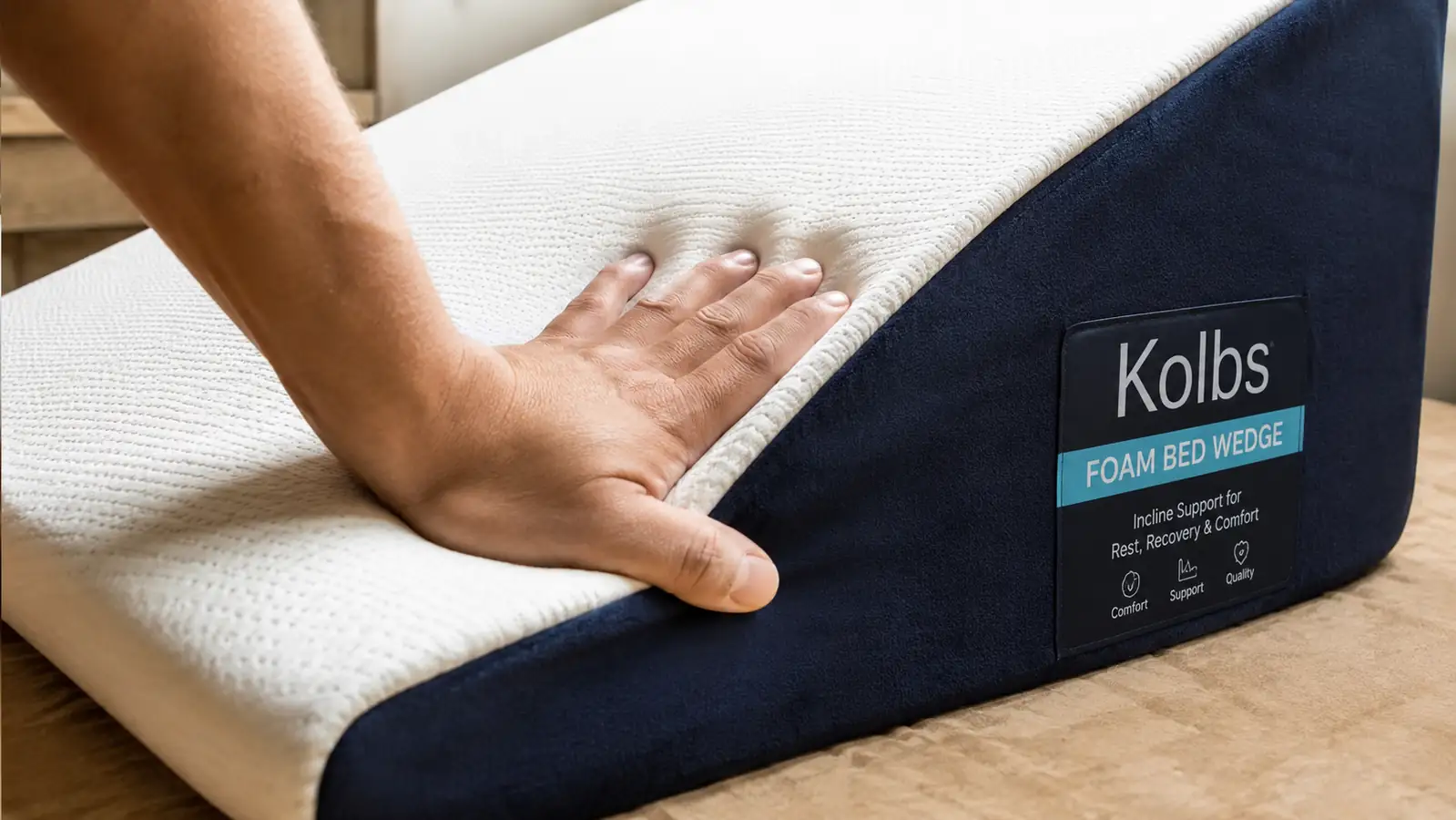
How Firm This Thing Actually Is
The listing calls it "medium firm memory foam," which is generous. This is firm. If you're used to a plush memory foam pillow that slowly cradles your head, the wedge is going to feel more like leaning against a padded board for the first week. I pressed into mine expecting some sink, and it gave maybe half an inch before it pushed back. My husband, who's used to a soft pillow-top mattress, tried it for one night and said it felt like sleeping against a car seat cushion.
The firmness is actually the point. A softer wedge would compress under your body weight over the course of the night and slowly flatten out your incline, which defeats the purpose if you're using it for reflux or sleep apnea. But that upside comes with a real adjustment period. My first four or five nights, I woke up with a stiff spot between my shoulder blades that I didn't have before. By week two that was gone, either because my body adjusted or because I'd finally found the right spot to actually rest my shoulders instead of my mid-back.
If you have a bad back already, or you're someone who needs a plush pillow to fall asleep at all, I'd test this cautiously. It is not a soft, forgiving surface, and I don't think enough reviews say that plainly before someone spends their money.
The Sliding Problem
This is the complaint I see most in other reviews, and it's real. My mattress is a memory foam hybrid, and the wedge pillow's foam-on-foam contact means it slowly migrates during the night. I'd fall asleep with it flush against my headboard and wake up with it three or four inches out of position, sometimes rotated slightly off-center. On nights when I moved around more, like after a big dinner or a glass of wine, I'd wake up around 3 a.m. with the wedge halfway down the bed and my head back on the flat mattress, reflux symptoms and all, because the incline had wandered off without me noticing.
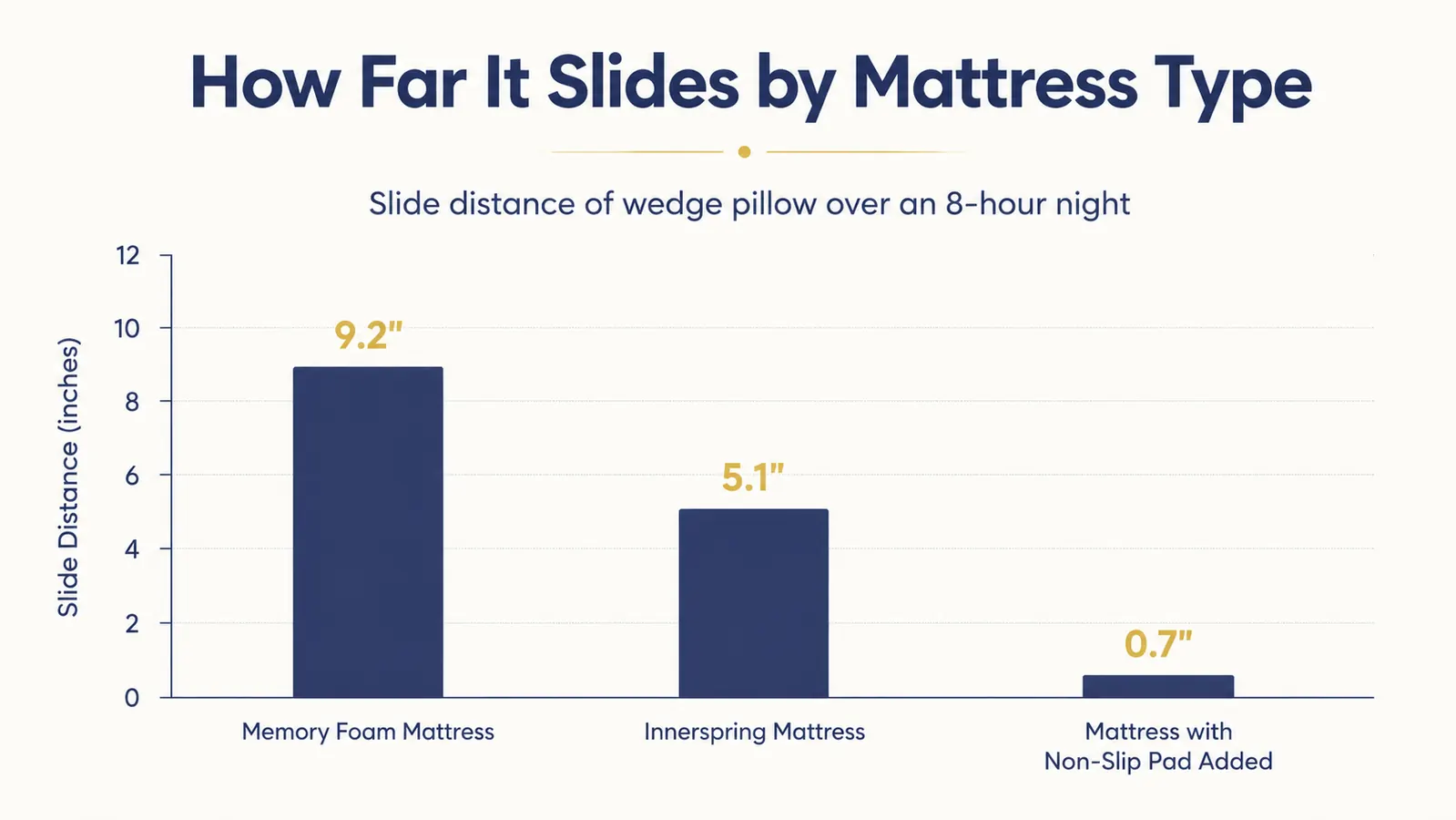
I ran an informal test on this for the sake of being useful to you. On my memory foam mattress with no grip aid, the wedge slid an average of about 4 inches over an 8 hour night. On my sister's innerspring mattress with a cotton sheet, it slid even more, closer to 6 inches, because the fabric-on-fabric surface has even less friction. When I added a thin rubber shelf liner underneath it, the sliding dropped to under an inch most nights. That fix cost me about six dollars and would have saved me a lot of irritation if I'd known to do it from day one instead of three weeks in.
So if you buy this, budget for a rubber grip pad or a non-slip shelf liner underneath it. The pillow itself doesn't come with anything to stop the slide, and on a smooth memory foam mattress, it will slide. I've also seen people use a strip of double-sided carpet tape between the wedge and a fitted sheet, which works but leaves a faint sticky residue on the sheet over time, so I'd stick with the shelf liner instead.
The Amazon photos show it sitting perfectly still against a headboard. Nobody photographs it at 3 a.m., four inches south of where you started.
The Size Question Nobody Answers Clearly
The Kolbs wedge comes in essentially one standard size, roughly 24 inches wide with about a 7 inch incline at the tallest point. That width is fine if you're a solo sleeper who stays roughly centered. It is not fine if you're broad-shouldered or you tend to sprawl. I'm 5'6", and the width works for me. My brother-in-law is 6'2" and broad through the shoulders, and when he tried mine for a weekend, his shoulders hung off both edges. He ended up feeling like he was balancing on a narrow beam rather than resting on a supportive surface, and he woke up with a sore neck both mornings.
The height is the other sizing issue. At 7 inches, it's a meaningful incline, enough to help with reflux and mild snoring, but it is not adjustable. If you need a steeper incline for more severe reflux, or a gentler one because 7 inches feels like too much too fast, you're stuck with what you get. I know people who stack a flat pillow on top of the wedge to add height, and others who fold a towel under the front edge to soften the angle slightly. Both are workarounds for a fixed design, not features, and neither one feels as stable as the wedge sitting flat on its own.
If you're a couple who wants to share one wedge, don't. It's built for one person. We tried sleeping side by side on it exactly once and it was cramped and awkward for both of us, closer to sharing a twin mattress than a queen. If that's your situation, it's worth reading my full comparison of the wedge against just stacking a few regular pillows, since stacking can actually make more sense for two people sharing a bed.
The Cover Isn't as Removable as It Looks
The listing shows a zippered cover, which is technically accurate, but getting the cover off and back on is more of a project than a five-minute task. The foam is snug enough inside the cover that removing it means basically wrestling a firm, oddly-shaped block through a zipper opening. I've done it twice in six months, once after a bad cold when I wanted to wash everything in the bedroom, and once just to check for dust buildup underneath. Both times it took me a solid ten minutes of pushing and repositioning to get the cover back on smoothly without bunching in the corners.
The cover itself washes fine and holds up well, no fading or pilling after multiple washes. My complaint isn't the fabric, it's the process of getting it off and on a rigid foam wedge. If you're someone who likes to wash pillow covers weekly, this isn't going to be a fun routine, and I'd honestly recommend a breathable pillow protector on top so you can wash that more often and leave the actual cover alone for longer stretches.
What I Liked
- Genuinely firm incline that doesn't flatten out overnight
- Helped reduce my nighttime reflux flare-ups noticeably within two to three weeks
- Cover washes well without fading or thinning
- Foam has held its shape with no visible sagging after 6 months
- Works well for reading or watching TV propped up, not just sleeping
Where It Falls Short
- Strong chemical smell for the first several days, needs airing out
- Slides on smooth mattress surfaces without an added grip pad
- Only comes in one width, too narrow for broad-shouldered or larger sleepers
- Fixed incline height, no way to adjust steeper or gentler
- Removable cover is a genuine hassle to take off and put back on
- Too firm for anyone who needs a plush, sink-in feel to sleep comfortably

What I'd Tell a Friend Shopping for This
If a friend asked me point blank whether to buy this, I'd tell her to buy the wedge and a six dollar shelf liner in the same order, so she's not sleeping on a sliding pillow for even one night while she waits on a second package. I'd also tell her to unbox it a couple days before she actually plans to use it, so the smell has time to clear out of the bedroom. Those two small moves would have solved almost every early complaint I had, and none of them are mentioned anywhere on the product page. She would also thank me for saying it plainly instead of just posting five stars: this pillow rewards patience. The first two weeks are the hardest part, and if she pushes through the smell, the stiffness, and the sliding, what's on the other side is a genuinely useful piece of sleep gear, not a miracle cure, just a firm, well-made incline that does its one job once it's set up right.
Who This Is For
This makes sense for a solo sleeper of average build who has mild to moderate reflux, post-nasal drip, or snoring, and who sleeps mostly on their back or slightly on one side. It's also a solid pick if you want an actual firm incline rather than a soft wedge that collapses by 2 a.m. If you're willing to spend six dollars on a grip pad and give it a few days to off-gas, most of the friction points in this review disappear. My mom, who's petite and sleeps flat on her back, had almost none of the issues I had, because her weight and sleep position don't push the pillow around as much as mine do.
Who Should Skip It
If you're a couple looking to share one incline pillow, skip this and look at a wider bed wedge system built for two, which I cover in my comparison against just stacking extra pillows. If you're broad-shouldered, over about 6 feet tall, or you know you need a steeper or gentler incline than a fixed 7 inches, this specific model is going to fight you. And if you're someone who needs a plush, cloud-like pillow to fall asleep, the firmness here will frustrate you more than it helps, at least for the first couple weeks.
I'd also skip it if you're not willing to buy a grip pad separately. Without one, the sliding will genuinely wreck your sleep on certain mattress types, and that's not a small footnote, it was my single biggest complaint for the first month I owned it. If any of this sounds too fiddly, it's worth reading how a wedge pillow saved my worst reflux nights before you decide, since that piece walks through what changed for me once I'd worked around these quirks.
Know your sleep position and mattress type before you buy
If you're a solo, average-build back or side sleeper willing to add a cheap grip pad, this is worth checking out at today's price on Amazon.
Amazon Check Today's Price on Amazon →